
From Junior to Senior
How Working on Large Projects Shapes Practical Skills


What challenges await a junior engineer when joining a large project?
Junior engineers entering a large software team or a project with an extensive legacy codebase often face overwhelming complexity. At this stage, confusion and a sense of uncertainty are natural, and many key skills are still underdeveloped. Small changes or fixes, if not considered from a system-wide perspective, can have ripple effects across other parts of the code that may not be visible initially.
This stage highlights the gap between limited hands-on experience and understanding the system as a whole. Junior engineers often face two main challenges: identifying the true causes of bugs and predicting the effects of small changes on the overall system. Confronting these issues, while initially daunting, becomes the starting point for deep learning and a strong awareness of the system’s structure.
Large projects resemble a complex puzzle; each seemingly simple piece can have wide-reaching effects on the entire picture. For example, changing a small section of code that appears insignificant may disrupt other parts of the program due to hidden dependencies, data flows, or inter-module interactions.
This experience strengthens observation, analysis, and the ability to predict the consequences of changes. Junior engineers gradually learn to make decisions more carefully, collaborate more effectively, and develop a deeper understanding of system architecture and data flow. Facing these challenges and solving smaller problems lays the foundation for professional growth and the ability to manage larger complexities.
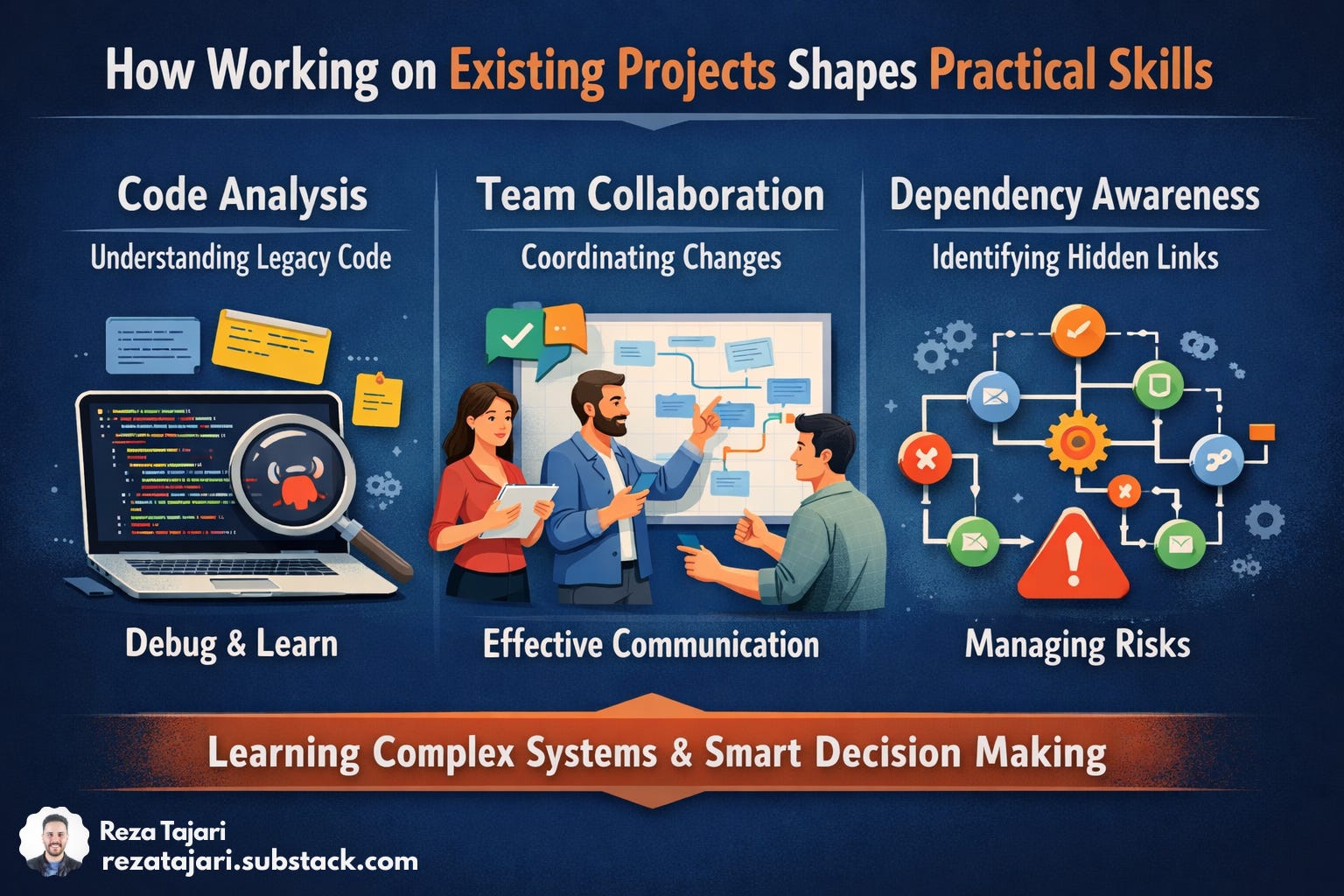
How working on existing projects shapes practical skills
Junior engineers often encounter code written by others, sometimes including complex sections, unconventional patterns, or hidden dependencies. At first, this can feel like trying to read a book with its chapters out of order.
In such situations, junior engineers learn to analyze and understand someone else’s code. Even addressing a small bug, which may seem trivial, can offer deep insights into the system. For instance, changing a variable may unintentionally affect another part of the program that appears unrelated, gradually developing the ability to predict the effects of changes and increasing awareness of system complexity.
Another key skill gained at this stage is understanding team standards and workflows. Observing system design, change management, and testing procedures demonstrates how a large, complex project operates in practice. This awareness helps decisions become more informed and less reliant on guesswork.
Team interaction and coordinating changes are also crucial. Junior engineers may initially think that small changes can be made independently, but any modification can have broad effects elsewhere. Experiencing coordination with colleagues strengthens responsibility and change-management skills.
A central lesson at this stage is recognizing hidden dependencies. Large projects contain networks of direct and indirect dependencies that are not immediately visible. Careful analysis of changes helps junior engineers understand that every small decision can trigger a domino effect, providing the foundation for intelligent decision-making and risk management.
Ultimately, working on existing projects not only develops practical skills but also provides deeper insights into the complex realities of software. Fixing bugs and managing small changes is highly valuable in practice and helps junior engineers develop decision-making, impact analysis, and problem-predicting skills effectively.

Turning initial fear into awareness and decision-making skills
Over time, with experience, initial fear and confusion give way to awareness, better understanding of the system, and confidence. At the beginning, even minor decisions may seem simple but have complex effects. Junior engineers often do not realize that changing a single line of code or variable can disrupt other parts of the system—this foundational realization gradually teaches analytical thinking and forecasting outcomes.
At this stage, responsible decision-making goes beyond coding skills. It involves analyzing changes, anticipating issues, managing dependencies, and evaluating potential risks. For example, modifying a simple method whose input is used in multiple sections without proper review can introduce complex bugs elsewhere. Experiencing such scenarios strengthens critical thinking and the ability to identify vulnerable areas in the system.
A critical skill in this phase is analyzing dependencies and cross-effects of changes. Junior engineers learn to identify and evaluate all related areas before implementing a modification, including related code, shared data, and module interactions. This process ensures decisions are more accurate, lower-risk, and reliable.
This stage also provides opportunities to combine hands-on experience with impact analysis. Keeping notes, creating checklists, and documenting dependencies allow junior engineers to act faster and more effectively in future situations. These practices reduce errors and build confidence in handling large projects.
Another important outcome is understanding the value of teamwork and consulting senior colleagues. Making decisions alone without coordinating with the team may lead to rework, conflicting changes, or new issues. Observing how changes are managed and collaborating effectively teaches that successful decisions combine careful analysis, practical experience, and effective team interaction—laying the foundation to become a trusted and professional engineer.
Ultimately, embracing this process and the art of decision-making shows that initial fear and confusion are natural and an integral part of professional growth. With patience, practice, precise analysis, and team feedback, junior engineers can make informed and responsible decisions, gain the confidence needed to manage large projects, and navigate from junior to senior.
Conclusion
The journey from junior to senior is full of challenges and hands-on experiences, each offering an opportunity to learn and develop professional skills. Working on large and complex projects, learning practical skills, analyzing the effects of small changes, and engaging continuously with the team strengthens not only technical knowledge but also decision-making and complexity management skills.
This journey demonstrates that initial fear and confusion are natural parts of growth. Through patience, ongoing practice, and careful reflection, junior engineers can make informed decisions, cultivate real professional skills, and gain the confidence required for managing major projects. Combining hands-on experience, analyzing small changes, and learning from team interaction forms the foundation for professional growth and the ability to make effective decisions in complex projects.
Success in this path is not merely a product of technical knowledge but also of commitment to continuous learning, flexibility in facing challenges, and the ability to leverage everyday experiences. This approach enables engineers to enhance their expertise while playing a decisive and impactful role in the success of projects and teams.
FAQ
Why can small changes in large codebases have serious effects?
Hidden dependencies and data flows can create domino effects that aren’t immediately visible.
How to deal with complex bugs in large projects?
First, reproduce the issue, analyze dependencies and potential effects, then apply solutions using practical experience and team standards.
How is decision-making skill shaped in large projects?
Through hands-on experience, analyzing effects, observing system behavior, and collaborating with the team, junior engineers learn that every small decision may have significant consequences.
Is working on existing projects enough or is separate learning required?
Hands-on experience is invaluable, but combining it with studying software architecture, design patterns, and independent projects develops comprehensive professional skills.
How is confidence gained when facing large projects?
By carefully analyzing bugs, understanding dependencies, observing effects, and collaborating with the team, junior engineers gradually gain the confidence to manage large projects and make effective decisions.
Source: Personal experience & Junior to Senior Career Advice for the Ambitious Programmer
For more detailed notes every week, subscribe👉 rezatajari.substack.com